The Earth does not speak. It leaves a record.
A literary archive-centered promise of the novel: not revelation, but evidence; not certainty, but trace.
Record
Evidence — note
Systems
Record
Status
Open
ITrace, not testimony
Sediment, filled fractures, drainage, noble gas data, old field notes. What is left behind, not what is said.
IINote on evidence
Archive Entry 09: The Earth Leaves a Record.
Every disturbance leaves a trace. Not always the one we expect. Not always where we are looking.
The record is not made for us. It is the consequence of processes that continue whether or not we notice them.
We do not find the record. We learn to read it without forcing it to agree with our timing.
The record is incomplete, irregular, and often ambiguous. It rarely preserves context. It does not arrive with an explanation.
But it persists.
Limestone, shale, soils, and stream gravels retain what air and argument forget. Structures settle, grains align, isotopes fractionate, and microfossils appear and disappear. The Earth edits ruthlessly and keeps what remains.
The archive exists because the Earth keeps time poorly and records well.
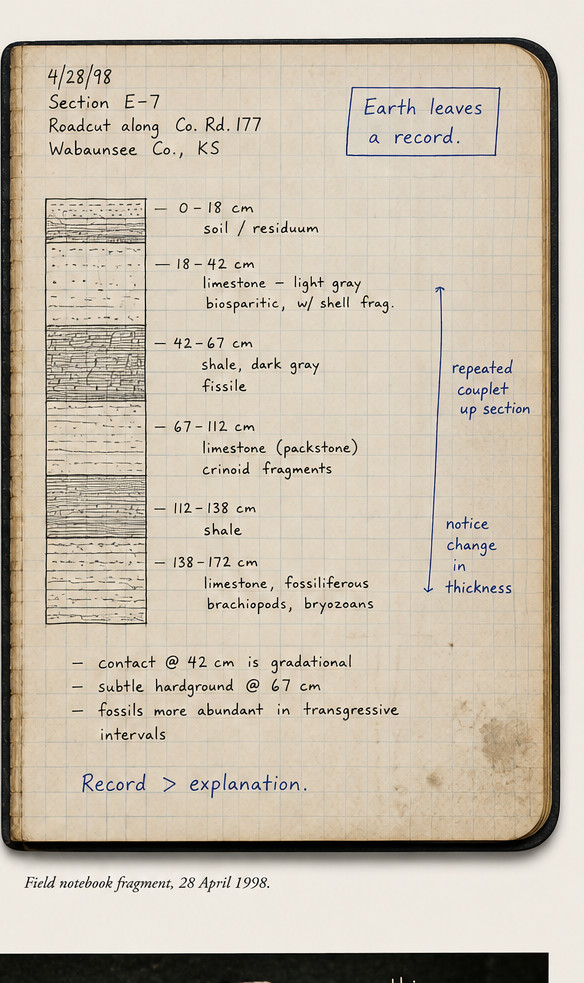
Notebook caption: Field notebook fragment, 28 April 1998.
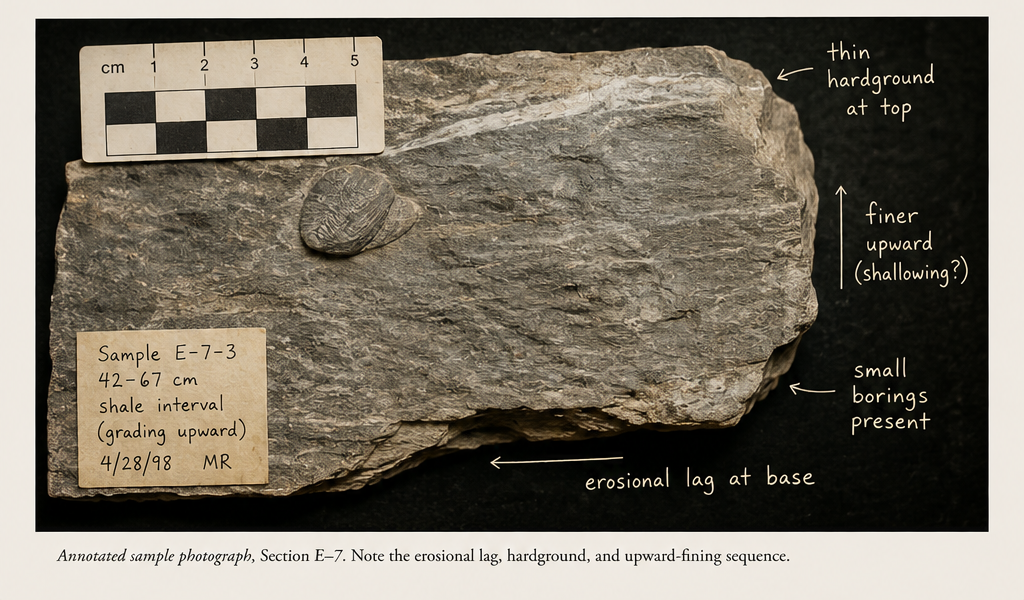
Sample caption: Annotated sample photograph, Section E–7. Note the erosional lag, hardground, and upward-fining sequence.
Notification
Be told when the record opens.
Release notification and occasional entries from the Rusk Archive. No hype, no schedule you did not ask for.